
Epigenetic Carcinogenesis: Quantitative Insights from HistoQuest Analysis
The evolving understanding of cancer biology underscores the pivotal role of epigenetic modifications - heritable yet reversible changes in gene expression that do not alter the DNA sequence.
single-cell analysis
tumor microenvironment
oncology
biomarker discovery
White Paper

Epigenetic Carcinogenesis: Quantitative Insights from HistoQuest Analysis
01 May, 2025
The evolving understanding of cancer biology underscores the pivotal role of epigenetic modifications - heritable yet reversible changes in gene expression that do not alter the DNA sequence.
Traditionally, cancer research was focused on finding the mutated genes including oncogenes which would contribute to disease development and progression, however, recent studies show that epigenetic changes may be equal drivers. These alterations, including DNA methylation and histone modifications, contribute significantly to tumor initiation, progression, and immune evasion. Importantly, these epigenetic alterations often exhibit spatial heterogeneity within tumor tissues, highlighting the value of imaging techniques in their study.
DNA methylation in breast tumors drives tumorigenesis
A study published in Clinical Epigenetics, 2024, assessed the extent of DNA methylation, particularly 5-hydroxymethylcytosine (5hmC) and 5-methylcytosine (5mC), in malignant breast tumors1. DNA modifications 5hmC and 5mC progressively decreased from usual ductal hyperplasia to atypical hyperplasia and then to ductal carcinoma in situ. These changes concentrated near transcription start sites and were closely linked to gene expression levels.1
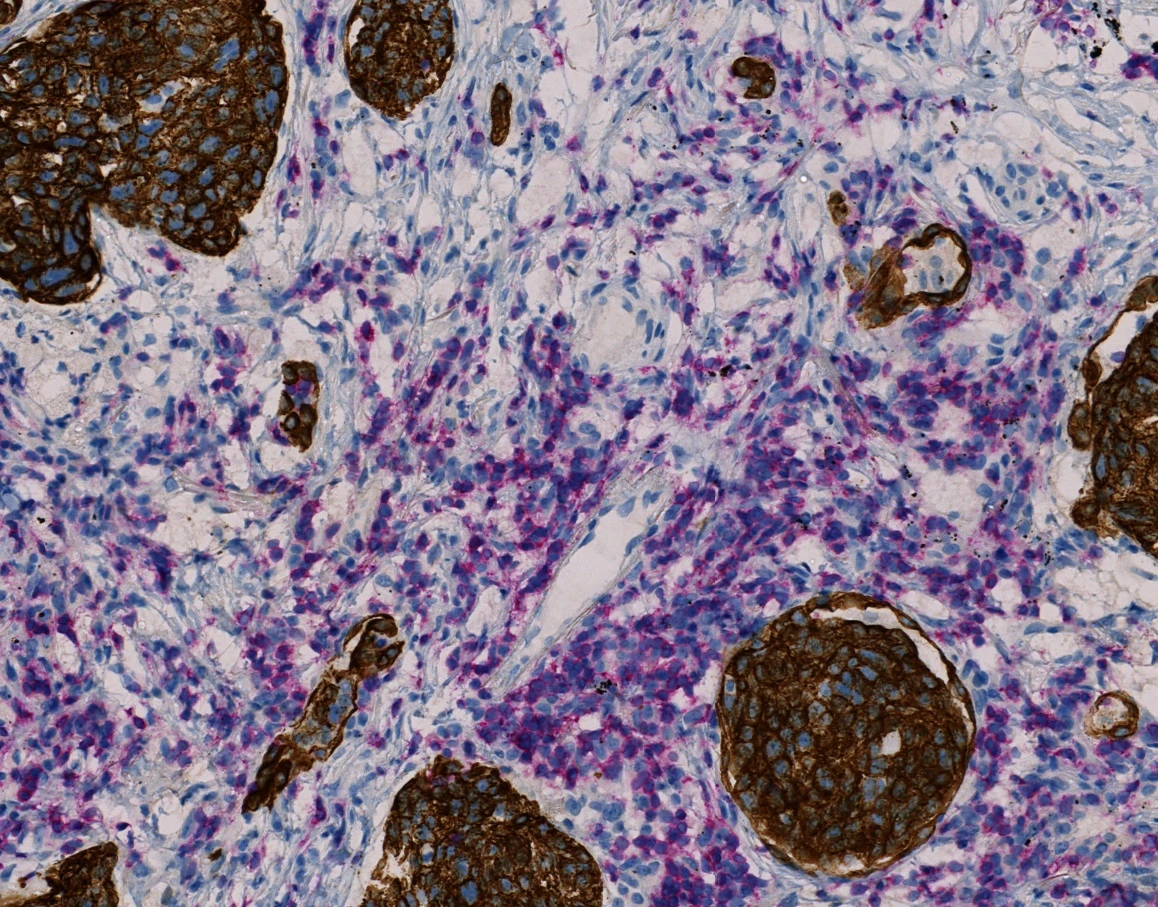
Interestingly, TET2-driven DNA demethylation was implicated in breast cancer development, with its associated regions enriched for binding sites of transcription factors ESR1, FOXA1, GATA3, and FOS. In addition to genomic experiments, the researchers vizualized 5hmC in tumor samples using IHC and acquiring images with TissueFAXS slide scanner. With HistoQuest image analysis software, they also could assess the relative level of DNA 5hmC in each sample. Their findings may be important for early-stage breast cancer screening and highlight the role of epigenetic cancerogenesis.1
Myc promotes cancer through SDHA acetylation and epigenetic changes
Myc is a well-researched oncogenic driver, however, in 2020 it was reported2 in Nature Metabolism that it may be also involved in the epigenetic regulation in cancers. The researchers show that Myc can inhibit succinate dehydrogenase complex subunit A (SDHA) by acetylating it, and this is a beginning of a biochemical cascade in cancer cells, ultimately leading to trimethylation of H3K4 tumor-specific gene expression. The group used TissueFAXS slide scanner to image the diffuse large B-cell lymphoma (DLBCL) lesions and normal lymph node samples. Next, they utilized HistoQuest image analysis solution to quantify the expression of Myc, SDHA and SIRT3.2
Metabolic enzyme ALDOB controls TGF-β expression in hepatocellular carcinoma (HCC)
DNA modifications are not the only epigenetic change playing an important role in cancers development and progression. A team from the City University of Hong Kong3 elucidated the effect of fructose-1,6-bisphosphate aldolase B (ALDOB) in hepatocellular carcinoma. It was shown to inhibit lysine acetyltransferase 2A and suppressing TGF-β 1 transcription. In case of ALDOB deficiency in HCC, TGF-β expression is increased which leads to increased count of T regulatory cells in the tumor microenvironment but also causes CD8+ T cell exhaustion, significantly worsening the prognosis. 3
Conclusion
To summarize, these studies underscore the growing need to investigate epigenetic mechanisms in cancerogenesis across multiple tumor types. From breast cancer to hepatocellular carcinoma, studies increasingly demonstrate that epigenetic changes not only accompany, but often promote tumor progression, immune evasion, and transcriptional reprogramming.
Crucially, these changes are not uniform across tissues and often exhibit spatial heterogeneity. Therefore, high-resolution imaging and quantitative analysis play an essential role in deciphering the functional epigenetic landscape within tumors. Technologies such as the TissueFAXS slide scanning system and HistoQuest image analysis software (TissueGnostics GmbH, Vienna) enable precise visualization and quantification of epigenetic changes, detected by corresponding staining methods directly in the native tissue environment.
TissueFAXS is an automated slide scanning platform that supports brightfield and fluorescence imaging, allowing high-throughput digitization of whole tissue sections at cellular resolution.
HistoQuest is an easy-to-use image analysis solution optimized for quantifying protein expression in tissues/cells. It provides cell-by-cell analysis, enabling researchers to assess marker expression levels and spatial distribution with statistical accuracy.
Together, these tools facilitate a more nuanced understanding of epigenetic cancerogenesis, offering insights that may support early detection strategies, therapeutic targeting, and personalized treatment approaches. To learn more about how TissueFAXS and HistoQuest can support your research in cancer epigenetics, contact TissueGnostics for a consultation or product demonstration.
Resources
- Wu, SL., Yang, L., Huang, C. et al. Genome-wide characterization of dynamic DNA 5-hydroxymethylcytosine and TET2-related DNA demethylation during breast tumorigenesis. Clin Epigenet 16, 125 (2024). https://doi.org/10.1186/s13148-024-01726-7
- Li, ST., Huang, D., Shen, S. et al. Myc-mediated SDHA acetylation triggers epigenetic regulation of gene expression and tumorigenesis. Nat Metab 2, 256–269 (2020). https://doi.org/10.1038/s42255-020-0179-8
- Yin, C., Zhang, C., Wang, Y. et al. ALDOB/KAT2A interactions epigenetically modulate TGF-β expression and T cell functions in hepatocellular carcinogenesis. Hepatology 81(1):p 77-93, January 2025. | DOI: 10.1097/HEP.0000000000000704
Latest Articles

Blog Post
11 Nov, 2026
EU rules on mercury and metal-halide lamps: what microscopy labs need to know
EU regulations on mercury-containing lamps are changing, raising questions about replacement bulbs and long-term microscope maintenance. Find out what the February 2027 exemption deadline means, how it affects existing microscopy systems, and why now is a good time to consider switching to LED illumination.

White Paper
01 Oct, 2026
A New Neutrophil Subset Suppresses Immunity Response in CRCLM
Within the tumor microenvironment, tumor-associated neutrophils (TANs) are gaining attention as important regulators of inflammation, immune suppression, and tissue remodeling. Recent studies suggest that specific neutrophil populations can actively support metastatic growth rather than simply responding to it.

News
14 Sept, 2026
TissueGnostics collaborates with Diya Biological Technology in organoid and organ-on-a-chip innovation
TissueGnostics, the trailblazer in Spatial Tissue Cytometry, has entered into a collaborative agreement with Diya Biological Technology Group Co., Ltd., a leading Chinese organ-on-a-chip CDMO and research service platform specialising in microfluidic organ chips, organoid banking and tumour drug-testing services.

