
Center of Excellence
Institute for Pathophysiology and Allergy Research, Centre for Pathophysiology, Infectiology, and Immunology at the Medical University of Vienna, Austria
Center of Excellence Award
The Institute for Pathophysiology and Allergy Research, Centre for Pathophysiology, Infectiology, and Immunology at the Medical University of Vienna is recognized as a TissueGnostics Center of Excellence for its long-standing collaboration and outstanding scientific contributions. The institute has produced numerous high-impact publications using TissueGnostics technologies and has been actively involved in many collaborative research projects. Their continuous engagement and innovation highlight a strong and highly impactful collaboration.

IPA, Centre for Pathophysiology, Infectiology, and Immunology, Center of Excellence award ceremony. From left to right, Martin Schepelmann , Rupert Ecker (CEO of TissueGnostics), Isabella Ellinger, Diana Mechtcheriakova and Anastasia Meshcheryakova
Interviews with Assoc. Prof. Diana Mechtcheriakova and Assoc. Prof. Isabella Ellinger
Using the power of systems biology to decipher multifactorial diseases and address the complexity of biological systems - Interview with Diana Mechtcheriakova
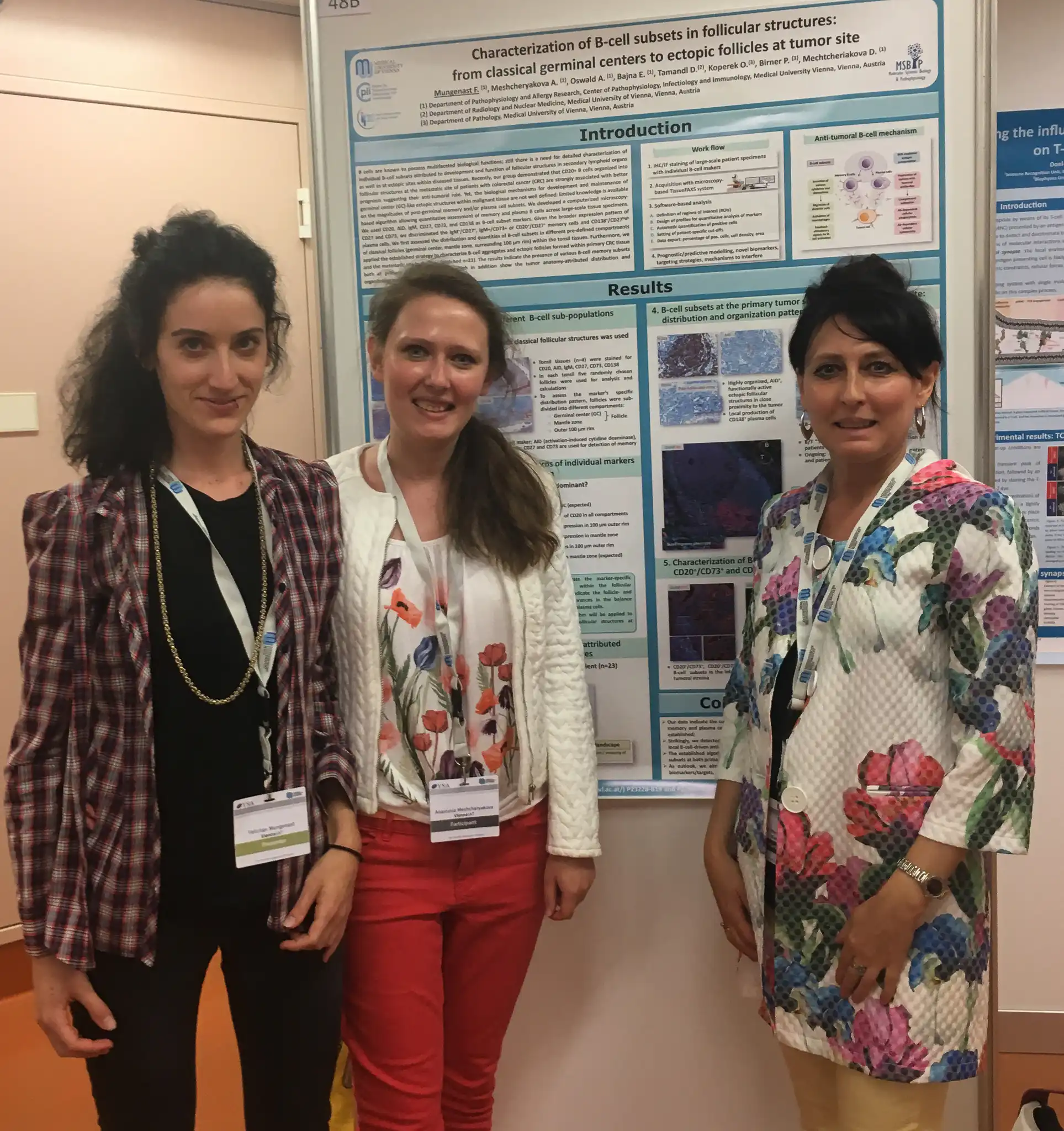
Diana Mechtcheriakova (right) with two former PhD students, Felicitas Mungenast (left) and Anastasia Meshcheryakova (center)
Briefly describe your research interests and role at the Institute for Pathophysiology and Allergy Research, Centre for Pathophysiology, Infectiology, and Immunology at the Medical University of Vienna.
I am an Associate Professor at the Medical University of Vienna in Austria and head of the Molecular Systems Biology and Pathophysiology research group at the Institute of Pathophysiology and Allergy Research, Center for Pathophysiology, Infectiology, and Immunology. Due to my deep expertise, I am also head of the technology subunit at BioImaging Austria, and of the Systems Medicine subdivision at the Austrian Platform for Personalized Medicine.
My scientific directions are systems biology and systems medicine as part of personalized medicine, B-cell biology, and immuno-oncology. Special interests refer to the AID/APOBEC-associated biological events; architectural complexity, functionality, and clinical relevance of lymphoid structures; developing of systems biology algorithms for the discovery of novel disease-/immune-associated checkpoints and patients’ stratification strategies; and the cellular sphingolipid system in immunity and cancer.
What TissueGnostics solutions do you use at your institute and how do they help you with your research?
My research group has been using the power of TissueGnostics technologies and supervising the incorporation of new developments for almost 14 years. The cornerstone of the next-generation quantitative tissue image cytometry is the computerized microscopy-based TissueFAXS platform for digitalizing the whole-slide tissue sections upon staining in IHC or IF.
The corresponding software packages, such as HistoQuest and TissueQuest, enable the analysis of digital images on the single cell level with the possibility for quantitative assessment across individual regions of interest, specified by a researcher, or across the entire digital tissue image. The analysis is further enforced by the unique properties of the StrataQuest software, which combines the information and extracts the knowledge based on both anatomical and cellular features of the analyzed tissue of the patient specimen. Overall, the tissue-encrypted information gets computationally transformed into numerical values, representing the variables for the follow-up analyses. We use the staining-derived datasets for alignment with clinicopathological parameters including patient stratification into risk groups and biomarker nomination. The advanced TissueFAXS-based technological solution provides the image-derived data in omics format and is an integral part of our systems biology approach, the DIICO – from Digital Immune Imaging to Clinical Outcome algorithm, to address the complexity of biological systems. This is image-driven systems biology as part of personalized medicine.
The DIICO strategy led us to the pioneering discovery of the formation of functionally active ectopic lymphoid structures at the metastasis in the liver of patients with colorectal cancer.
DIICO algorithm enabled us to transform tissue-encrypted information on immune cells and lymphoid structures into 24 variables for the assessment of their clinical relevance. We showed a strong prognostic effect of immune phenotype characteristics of lymphoid structures not only at the metastatic site but, surprisingly, also in normal colon mucosa of patients with metastatic colorectal cancer.
- Mungenast F.*, Meshcheryakova A.*, Beer A., et al. and Mechtcheriakova D. The Immune Phenotype of Isolated Lymphoid Structures in Non-Tumorous Colon Mucosa Encrypts the Information on Pathobiology of Metastatic Colorectal Cancer. Cancers 2020. doi: 10.3390/cancers12113117. This study gives novel clinically relevant insights into the role of lymphoid structures in cancer pathobiology gained using quantitative tissue image cytometry as an innovative technological solution within the newly developed DIICO algorithm.
- Meshcheryakova A., Svoboda M., Jaritz M., et al. and Mechtcheriakova D. Interrelations of sphingolipid and lysophosphatidate signaling with immune system in ovarian cancer. Computational and Structural Biotechnology Journal. 2019. doi.org/10.1016/j.csbj.2019.04.004. The first study addressing joint impact of sphingolipid/lysophosphatidate systems on ovarian cancer pathobiology in conjunction with local immune response implementing a newly developed holistic approach – the MuSiCO algorithm. Digital pathology using the TissueFAXS platform is one of the modules of MuSiCO.
- Meshcheryakova A., Tamandl D., Bajna E., et al. and Mechtcheriakova D. B cells and ectopic follicular structures: novel players in anti-tumor programming with prognostic power for patients with metastatic colorectal cancer. PLoS One. 2014. doi: 10.1371/journal.pone.0099008. Pioneering work interrelating B cells and lymphoid structures with clinical outcome of patients with metastatic colorectal cancer; proposal of novel patient stratification models based on biomarkers discovered using whole-slide computerized quantitative microscopy.
- Meshcheryakova A., Zimmermann P., Ecker R., et al and Mechtcheriakova D. An Integrative MuSiCO Algorithm: From the Patient-Specific Transcriptional Profiles to Novel Checkpoints in Disease Pathobiology. In: Rajewsky N., Jurga S., Barciszewski J. (eds) Systems Biology. RNA Technologies. 2018. Springer, Cham DOI https://doi.org/10.1007/978-3-319-92967-5_18. This book chapter gives a detailed description of the multi-modular integrative MuSiCO algorithm applicable for deciphering the pathomechanisms of complex multifactorial diseases.
- Meshcheryakova A., Mungenast F., Ecker R., Mechtcheriakova D. Tissue image cytometry. Imaging Modalities for Biological and Preclinical Research: A Compendium, Volume 1. 2021. (pp. I.2.h-1-I.2.h-10): IOP Publishing. doi.org/10.1088/978-0-7503-3059-6ch14. The book chapter gives detailed insights into digital tissue image cytometry in basic and translational research.