
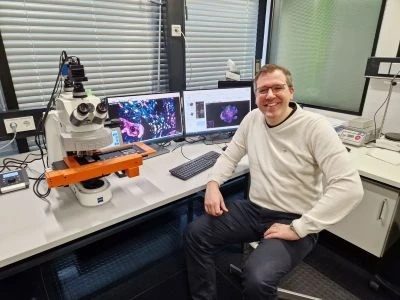
Department of General, Visceral, and Transplant Surgery, RWTH Aachen
The Department of General, Visceral and Transplant Surgery at RWTH Aachen University Hospital is recognized as a TG Center of Excellence for its strong and long-standing collaboration. Led by Prof. Klinge and Dr. Dievernich, the team has made significant scientific contributions through numerous high-impact publications using TissueGnostics technologies, as well as active participation in joint webinars and conference activities. »Read the interview with Dr. Axel Dievernich.
Interview with Dr. Axel Dievernich
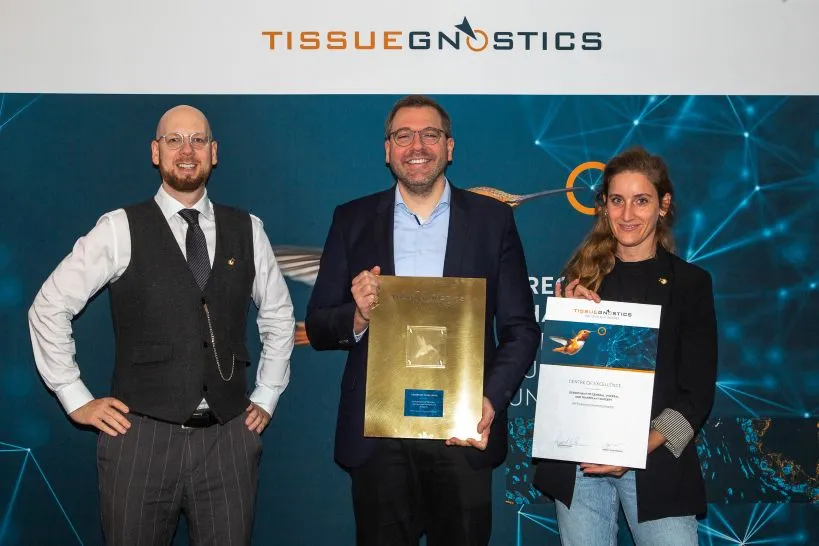
Department of General, Visceral, and Transplant Surgery at University Hospital RWTH Aachen Center of Excellence award ceremony. From left to right, Rudolf Jedletzberger, Axel Dievernich and Felicitas Mungenast.
Briefly describe your research interestsand role at the Department of General, Visceral, and Transplant Surgery at University Hospital RWTH Aachen.
My research interests include the study of immune cells in their tissue context, e.g. immune cells involved in tissue responses to biomaterials, using multiplex immunofluorescence microscopy as well as image processing and analysis.
So far, I have mainly done research at the Department of General, Visceral, and Transplant Surgery at RWTH Aachen University Hospital, where I have collaborated with the Department of Neurology and the Institute of Pathology, among others. I have also collaborated with the Institute of Imaging and Computer Vision at RWTH Aachen University and the Division of Infection and Immunity at Cardiff University.
What TissueGnostics solutions do you use at your institute and how do they help you with your research?
For imaging and image acquisition, we use the TissueFAXS PLUS Scanning System, which consists of an Axio Imager 2 epifluorescence microscope with the Colibri 7 light source, a motorized reflector turret, and a high-precision stage for scanning whole slides; the freely available TissueFAXS Viewer software is used for image viewing; and StrataQuest is mainly used for image processing and quantitative analyses.
What are your most important reference publications?
- Dievernich A, Stegmaier J, Achenbach P, et al (2023) A Deep-Learning-Computed Cancer Score for the Identification of Human Hepatocellular Carcinoma Area Based on a Six-Colour Multiplex Immunofluorescence Panel. Cells 12:1074. https://doi.org/10.3390/cells1207107
- Klinge U, Dievernich A, Stegmaier J (2022) Quantitative Characterization of Macrophage, Lymphocyte, and Neutrophil Subtypes Within the Foreign Body Granuloma of Human Mesh Explants by 5-Marker Multiplex Fluorescence Microscopy. Front Med 9:777439. https://doi.org/10.3389/fmed.2022.777439
- Dievernich A, Achenbach P, Davies L, Klinge U (2022) Characterization of innate and adaptive immune cells involved in the foreign body reaction to polypropylene meshes in the human abdomen. Hernia 26:309–323. https://doi.org/10.1007/s10029-021-02396-7
- Klinge U, Dievernich A, Tolba R, et al (2020) CD68+ macrophages as crucial components of the foreign body reaction demonstrate an unconventional pattern of functional markers quantified by analysis with double fluorescence staining. J Biomed Mater Res jbm.b.34639. https://doi.org/10.1002/jbm.b.34639
